
Gallery

Discovering the sacred sites of Irish mythology offers a profound way to connect with the legendary women who inhabit these ancient tales.


In Author Deborah Sheehy’s forthcoming book The Untold Stories of Ireland’s Goddesses, she delves deeply into the stories of Ireland’s remarkable Goddesses and their legacies for today. She also places a special focus on the sacred landmarks these ancestral women embody.


Until the book is ready for publication, enjoy exploring photos and descriptions of some of the sites that hold a special place in Deborah’s heart.


All content and photos are the copyright of Deborah Sheehy. A bibliography is provided at the bottom of this page.


While we are fortunate that it is still possible to visit so many of Ireland’s ancient landmarks, it’s important that we thread carefully when we go there, as unfortunately some of them have been damaged by visitors. If we can all be mindful not to ever walk on top of any of the cairns or ever light a fire, leave any debris behind us or take stones or anything else from the site, then we can play our part in passing onto future generations the wonderful legacy that our ancestors have given us.
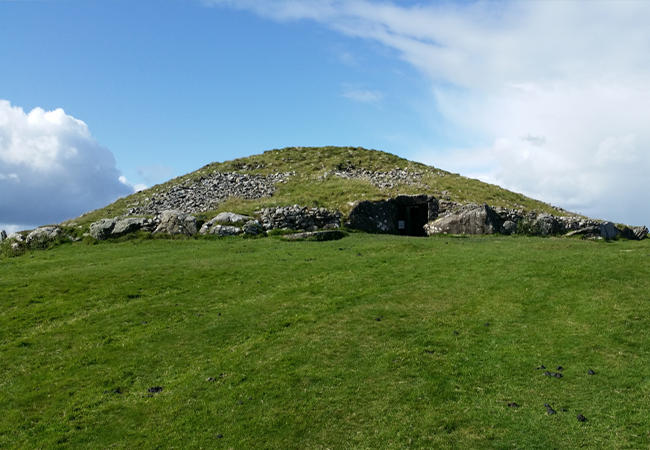
Sliabh na Cailleach (Hill of the Cailleach), Loughcrew, Co. Meath

The Cailleach represents one of the oldest forms of the Goddess, often depicted as a divine hag. According to Irish mythology, she sculpted parts of the landscape, and her cairn (Cairn T) at the peak of Sliabh na Cailleach dates back over 5,200 years.


This ancient site aligns with the Spring and Autumn equinoxes, when the rising sun illuminates exquisite indigenous carvings within the chamber.(1) Spread across these hills are over 30 neolithic cairns, marking this place as a deeply significant sacred site.   


1. Brennan, Martin (1994)


Sliabh na Cailleach, Loughcrew
The Rath of Queen Medb Tara

The Rath of Queen Medb Lethderg, Tara, Co. Meath

In Irish mythology, Queen Medb Lethderg ensured no king could rule at Tara without uniting with her in a sacred marriage ritual called the Ban Fheis. Medb was married to nine successive High Kings of Tara. Some believe this Queen Medb of Tara to be different from Queen Maeve of Connaught and others see them as a representation of a similar sovereign Goddess energy.(1)


According to the Dindshenchas (Lore of Places), Medb Lethderg is one of the three great Queens of Ireland, alongside Queen Maeve of Connaught and Queen Macha of Armagh. They are described as women of fiery force who had handsome consorts and who performed deeds of daring greater than all the exalted kings.(2)


1. MacKillop J. (1998) P. 328
– Berresford Ellis, P. (1987) P.166
2. Gwynn, E. J. (1903-1935) M.D. Vol III, Poem 65, Ath Luain

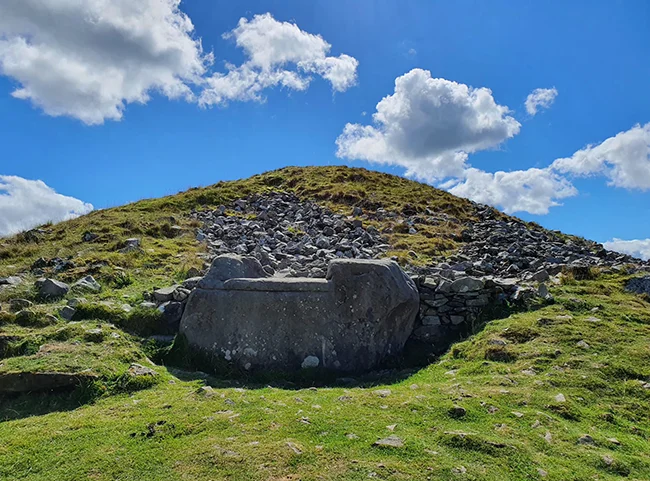
The Chair of the Cailleach, Cairn T, Loughcrew, Co. Meath

Local folklore tells of the Cailleach skipping from hill to hill, shaping the land as stones tumbled from her apron. One of these stones formed a natural throne, known as the Chair of the Cailleach, where she was said to survey the land.(1)


The front of the chair is intricately decorated with carvings of concentric circles, cup marks, and other designs. At the spring equinox, a beam of light strikes the ‘daisy’ near the top left and follows the zig-zags towards the next daisy-like feature.(2)

Positioned at the highest point in County Meath, the hill offers beautiful views of the surrounding counties.


1. Hull, E. (1927) P. 246
2. Murphy, A. (Ancient Sites/Loughcrew-Sliabh na Calliagh)

The Chair of the Cailleach Loughcrew
Ail na Muireann (the Stone of Divisions), Hill of Uisneach, Co. Westmeath

Ail na Muireann (Stone of Divisions), Hill of Uisneach, Westmeath

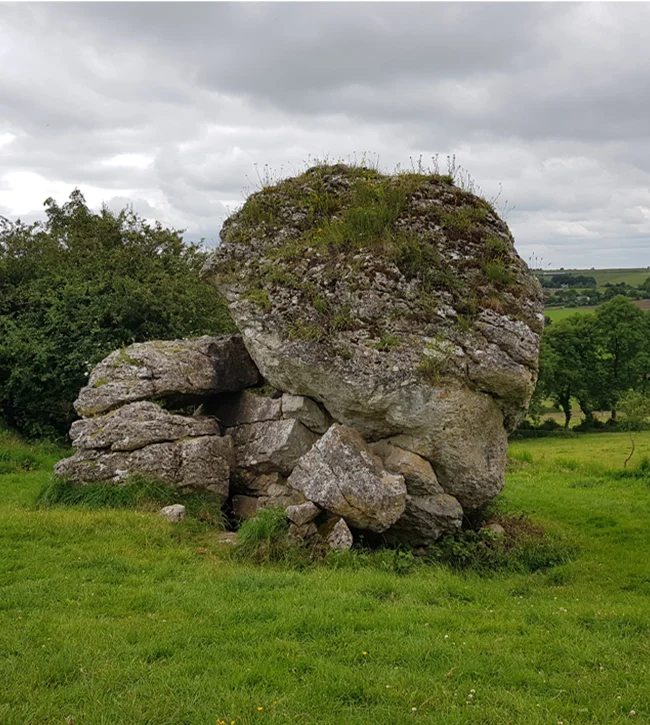
This sacred catstone, resting on the Hill of Uisneach, is the final resting place of Éire/Ériu, the sovereignty Goddess of the Tuatha Dé Danann. Éire after whom Ireland (Éireann) is named, played a vital role in negotiating with the Gaels after their arrival to the island.


When Amergin and the Gaels encountered her on Uisneach, she appeared as a shape-shifting figure, transforming from a beautiful black-browed, wide-eyed woman to a sharp-beaked grey-white crow.(1) She declared that they would have no gain, nor their children, on the land, unless the land would bear her name, ensuring her lasting legacy.(2)


It is on the hill of Uisneach, that Éire in her role as Sovereignty Goddess, also conferred kingship onto future kings through the sacred marriage ritual of the ‘Ban Fheis’. As a sacred site, Uisneach symbolizes the symbolic centre or navel of Ireland, with the catstone being a portal to the mythical Fifth Province, believed to be a spiritual realm connecting the island’s four traditional provinces. This historic ceremonial site consists of numerous monuments and earthworks.(3)


1. Gregory, A. (1904)
2. Macalister, R.A.S. (1941) 3rd Redaction, Sec VIII.
– Macalister, R.A.S. (1941) Parts 1-5.
– Dobs, M. Ní C. (1937)
3. Uisneach, Hill of Website

Meascán Mhéabha, Queen Maeve’s Cairn, Knocknarea Hill, Co. Sligo

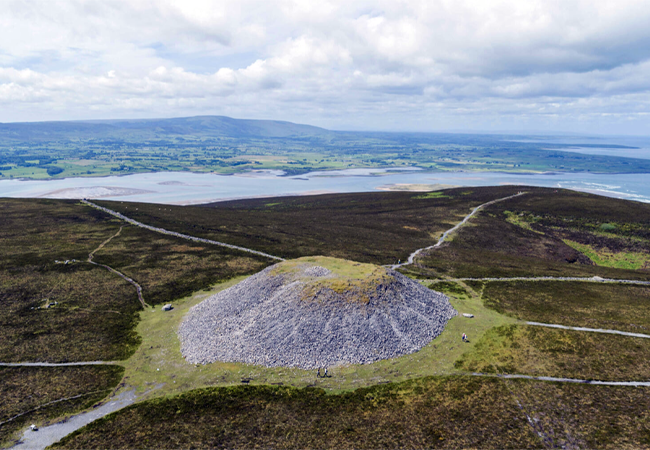
Perched atop Knocknarea Hill, this spectacular cairn is thought to be the resting place of the infamous Queen Maeve of Connaught. Legend holds that she is buried standing upright, clad in battle armour, and facing her enemies in Ulster.


Dating back over 5,500 years, the cairn is one of Ireland’s largest neolithic monuments and has yet to be excavated. It was built in a deliberate manner that creates a ritual presence to the surrounding land and coastline. There are few pre-historic monuments anywhere in the world that have so dramatically altered the landscape in the same way that Maeve’s Cairn does. (1) It commands a striking presence and is one of a network of ancient sites dotting the peninsula.


1. National Monuments Service (Jul 2020)

Credit Photographic Archive, National Monuments Service, Gov. of Ireland

Meascán Mhéabha, Queen Maeve’s Cairn, Knocknarea Hill, Co. Sligo
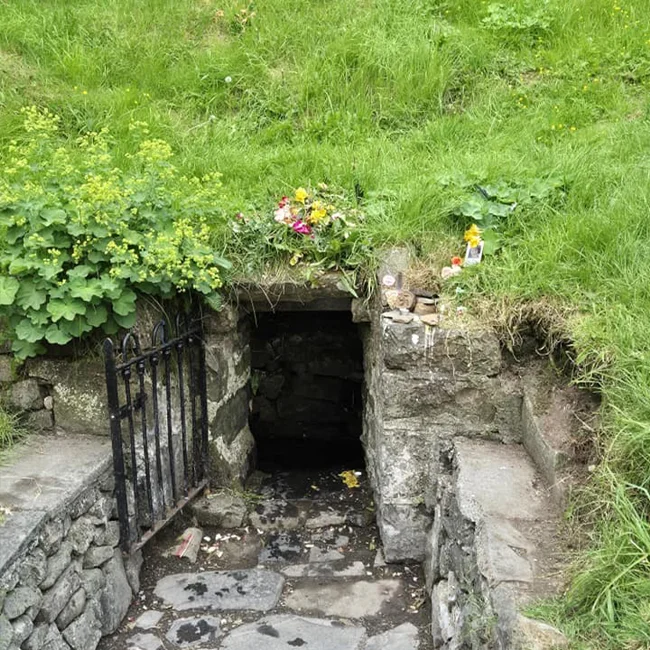
Tobar Bó Finne, Well of the White Cow, Tara, Co. Meath

Tobar Bó Finne, Well of the White Cow, Tara, Co. Meath

Lady Jane Francesca Wilde’s 1888 folklore collections tell of Bó Finn, a mystical White Cow who magically appeared to the people of Ireland, bringing sustenance to all its inhabitants. Wells and lakes where Bó Finn drank from became named after her.(1)


Bó Finn is also linked to the Tuatha Dé Danann Goddess Bóinn whose name comes from the old Irish word ‘Bó Find’ meaning ‘White Cow’ or the ‘Wisdom Giving Cow’.(2) The white cow often represents the Goddess in bovine shape and was seen as an object of veneration since antiquity.(3)


The Well of the White Cow is situated at the base of the Hill of Tara, the ceremonial and inauguration landmark of Ireland’s High Kings. It is one of Tara’s six wells and has been lovingly restored. It is a tranquil spot steeped in history and mythology.


1. Wilde, L. J. (1888)
2. O’hOgáin, D. (2006) P. 38
3. Wilde, L. J. (1888)

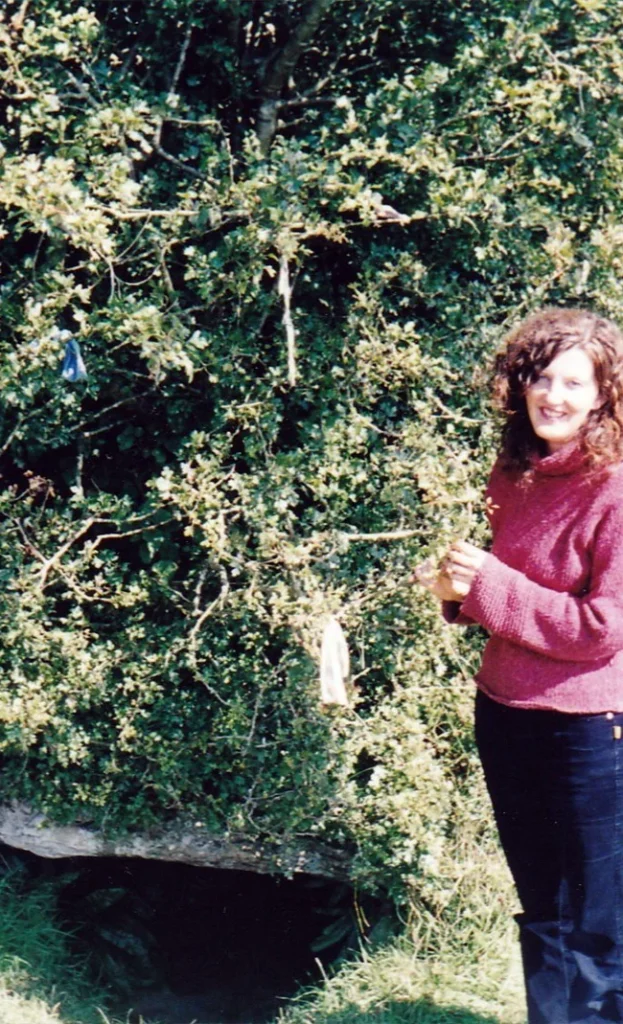
Oweynagat (Uaimh na gCait), Cave of the Cats, Rathcrogan, Co. Roscommon.

Photo of the author at Oweynagat taken in 2002

The mystical cave of Oweynagat is situated at Cruachan, the ancient royal capital of the West of Ireland. It features richly in the myths as an important Otherworldly portal. It is known as the fit abode of the Mórrígan,(1) a formidable warrior Goddess from the magical race of the Tuatha Dé Danann, who appears in several legends often in supernatural ways. In the Táin, the Mórrígan corralled important cattle she was guarding into this cave in preparation for future events that were yet to unfold. (2)


Oweynagat is also associated with the famous Celtic warrior Queen Maeve along with her mother. The cave and nearby rath are said to be named ‘Sí Cruachan’ or ‘Crochan’s Abode’ after Maeve’s mother Crochen Croderg.(3) It earned its name ‘Cave of the Cats’ from a legend where Maeve commanded three terrifying cat-like beasts to emerge from the cave to test the strength of Ulster’s finest champions.(4) Maeve’s name is inscribed in ogham (the old Irish alphabet) on a large lintel stone just inside the entrance.


It is one of three main entrances to Ireland’s Otherworlds and is renowned for being the origin of Halloween.(5) Ireland’s mythical Otherworlds are akin to another realm, usually a delightful place (but not always), where the Gods and Goddesses of the Tuatha Dé Danann (the Sí) retreated to after they were defeated by the Gaels.(6)


The entrance to the cave is through a small gap in the earth that extends to an underground cavern below. It is situated south of Rathcrogan Mound near Tulsk in County Roscommon and guides from the Rathcrogan Visitor Centre lead tours to the cave.


1. Gwynn, E. J. (1903-35) M.D. Vol IV, Poem 49, Odras
2. Leahy, Arthur, H. (1906) (Táin Bó Regamna)
3. Gwynn, E. J. (1903-35) M.D. Vol III, Poem 63, Rath Cruachan.
– Stokes, W. (1894-5) R.D. Vol II Poem 65, Raith Cruachan.
– Gregory, A. (1902) Cruachan.
– Meehan, C. (2002) P.582
4. Gregory, A. (1902) (The Championship of Ulster)
5. Rathcrogan Visitor Centre Website
6. MacKillop J. (1998) P. 359

Oweynagat (Uaimh na gCait), Cave of the Cats, Rathcrogan, Co. Roscommon.
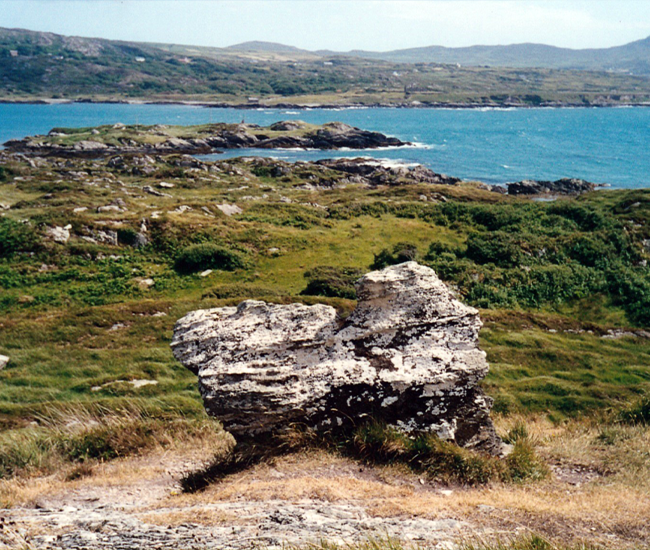
Cailleach Beara’s Rock, Coulagh Bay, near Eyeries, Beara Peninsula, Co. Cork

Cailleach Beara’s Rock, Coulagh Bay, near Eyeries, Beara Peninsula, Co. Cork

The beautiful wild landscape of the Beara Peninsula in the southwest of the country is named after the ‘Cailleach Beara’ or the ‘Hag of Beara’. It features many ancient monuments including stone circles, ogham stones and dolmens where the Cailleach features prominently.


A large rock near Coulagh Bay is said to represent the fossilized remains of the Cailleach Beara where she turned to stone. Folklore tells us she looks out towards the ocean there waiting for her consort, Manannán, God of the Sea, to return to her.(1)


This spot is a favourite of the author’s and has a very ancient and ethereal feel to it. It is situated near Ballycrovane Harbour and overlooks three small fields connected to the Cailleach, one of which is called ‘the field of the fair woman’.(2)


1. Meehan, C. (2002) P. 533
2. O’Brien, D. M. (1991)

Bibliography

Berresford Ellis, Peter, (1987) A Dictionary of Irish Mythology. London, UK: Constable & Co Ltd

Best, Richard, I. (1910) The Settling of the Manor of Tara, Ériu Journal, Vol 4, Dublin: School of Irish Learning.

Brennan, Martin (1994) The Stones of Time: Calendars, Sundials and Stone Chambers of Ancient Ireland. Vermont, USA: Inner Traditions.

Dobs Ní, Maighréad, C. (1937) “Tochomlad mac Miledh a hEspain i nErind”, The Progress of the Sons of Mil from Spain to Ireland. Études Celtiques. v.II. Paris.

Hull, Eleanor (1927) Legends and Traditions of the Cailleach Bheara or Old Woman (Hag) of Beare. Folklore, Vol 38, No 3. UK: Taylor & Francis Ltd.
Gregory, Augusta, Lady (1902) CuChulain of Muirthemne. UK: John Murray 
Gregory, Augusta, Lady. (1904) Gods and Fighting Men. UK: John Murray 
Gwynn, Edward, J. (1903-1935) The Metrical Dindsenchas (Ed. & Tr.) Todd Lecture Series. Ireland: Hodges Figgis.
Leahy, Arthur, H. (1906) Heroic Romances of Ireland, Volume II. (Ed. & Tr.) The Yellow Book of Lecan. UK: David Nutt. Táin Bó Regamna (The Cattle-Raid of Regamna)

Macalister, Robert, A.S. (1938-1956)) Lebor Gabála Érenn: Book of the Takings of Ireland. Dublin: Irish Texts Society.

MacCoitir, Niall (2003) Irish Trees: Myths, Legends and Folklore. Cork, Ireland: The Collins Press.

MacKillop James, (1998) A Dictionary of Celtic Mythology. Oxford UK: Oxford University Press.
Meehan, Cary, (2002) The Traveller’s Guide to Sacred Ireland. UK: Gothic Image Publications
Murphy, Anthony. Website: https://mythicalireland.com/Ancient Sites/Loughcrew-Sliabh na Calliagh

National Monuments Service (Jul 2020) Neolithic Sligo-the passage tombs of Carrowmore and Knocknarea. Video
O’Brien, Daniel M. (1991) BEARA A Journey Through History. 135 Cork: Beara Historical Society
O’hOgáin, Dáithí. (2006) The Lore of Ireland: An Encyclopaedia of Myth, Legend and Romance. Cork, Ireland: Collins Press and Suffolk, UK: Boydell Press
Rathcrogan Visitor Centre Website. https://www.rathcroghan.ie/
Stokes, Whitley (1894-95) The Rennes Dindsenchas. Revue Celtique Vols 15 & 16
Uisneach, Hill of, Website. https://uisneach.ie/
Wilde, Lady Jane. (1888) Ancient Legends, Mystic Charms and Superstitions of Ireland.

Book a Consultation

If you’re interested in working with Deborah, she offers a brief, no-obligation 5-10 minute phone call to discuss whether her approach is right for you.